





I met Tarun Sarkar* in Jagannath Hall, Dhaka University’s hostel for Hindu students. I was to interview him about the upcoming elections in Bangladesh, the first after Prime Minister Sheikh Hasina was deposed in 2024.
“We can chat over lunch in one of the student messes,” Sarkar, 28, a former student of Dhaka University said. “But first let me give you a tour of Jagannath Hall. It is a historic place.”
The first spot Sarkar took me was a memorial for the students and professors of Jagannath Hall massacred by the Pakistan Army in 1971. One hundred and forty people – students, professors and staff – were killed as Pakistan began Operation Searchlight, their genocidal military crackdown on the territory that was then called East Pakistan.
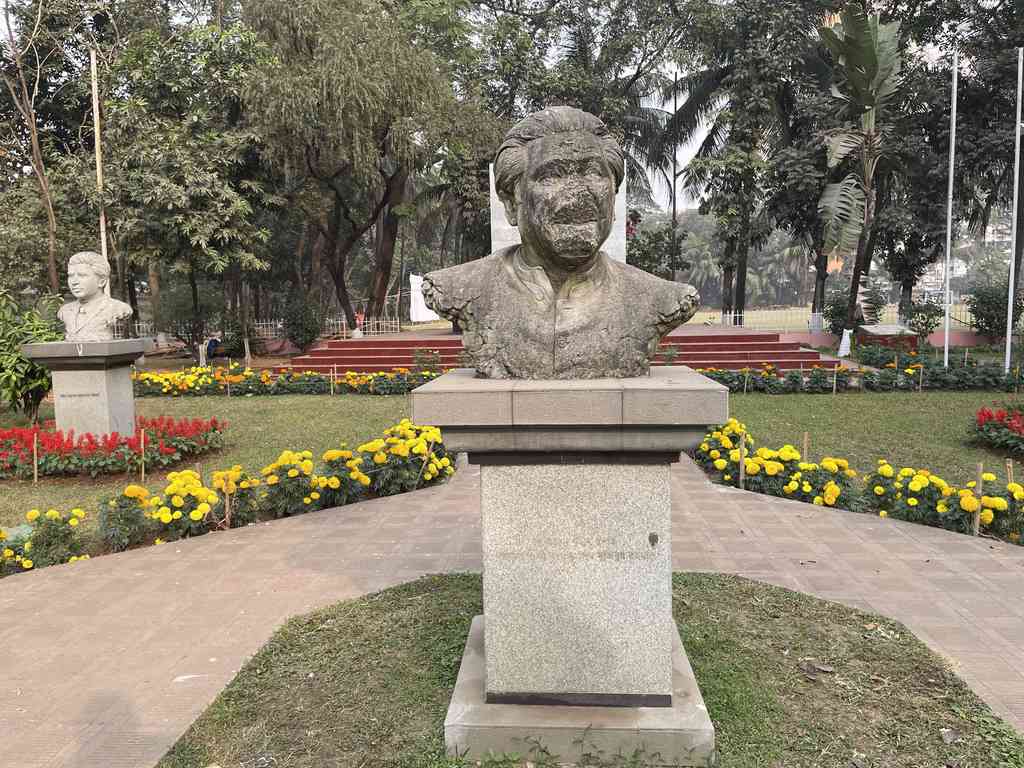
On August 5, 2024, after Hasina fled to Delhi, Sarkar said mobs entered Jagannath Hall and vandalised a statue of Bangladesh’s first prime minister Sheikh Mujibur Rahman, located right by the memorial.
“This place [Jaganath Hall] shed blood so that East Pakistan could become Bangladesh,” he said. “Those people want to make Bangladesh East Pakistan again.”
He disagreed with the popular triumphalist narrative around the July uprising that unseated Hasina. “For minorities, the past 18 months has been a very difficult time,” Sarkar said. “Most Bangladeshis might look forward to the election, but for Hindus, it is a very tough decision. We will vote under a pall of fear.”

Exit Awami, enter Jamaat
Sheikh Hasina’s 16-year long reign was marked by widespread allegations of authoritarianism and fixed elections. When a student-led uprising toppled her ministry, she fled to Delhi. The interim government that took power after her, banned her party, the Awami League.
For much of Bangladesh’s history, the country has been a political duopoly. The Awami League, which led the country’s fight for freedom, broadly stood for a secular Bengali nationalism while the Bangladesh Nationalist Party, championed a sort of Bangladeshi Muslim nationalism. With the Awami League gone, the Islamist party that had supported Pakistan in 1971, the Jamaat-e-Islami, has gone from being a niche outfit electorally to being a serious competitor to the Bangladesh Nationalist Party.
Traditionally, Bangladeshi Hindus have supported the Awami League. This even though Sarkar says the party actually failed to stop the rise of the Islamist right. “The Awami never protected us physically,” he said. “We saw constant riots under Hasina’s rule. The only thing they gave us, to some extent, were jobs. Now even that will end.”
Thirty-year-old Tapti Adhikari* described Hasina’s treatment of Islamists as a “betrayal of the country”. Hasina could easily have finished off the Islamists if she wanted, Adhikari contended, but “instead, she tried to finish off the BNP”.
In spite of these imperfections, the Awami League still enjoys wide support among Bangladeshi Hindus. “The development that Hasina did, Bangladesh has never seen anything like it,” Saurabh Ghosh*, a 71-year-old resident of Dhaka said. “She created an economic miracle. There was no hunger, Bangladeshis had work. See the slowdown after she left.”
He is angry that the Awami League is banned from contesting the polls, claiming that if it were allowed, it would get 40% of the vote. “That is what they [the interim government] are scared of,” he said.
A vote against the right
With the Awami League banned from the ballot, where the Hindu vote will go is a burning question. “We would actually like to boycott the election,” said Ranjan Karmakar of the Bangladesh Hindu Buddhist Christian Unity Council. “And many Hindus will. They will pretend to go to the booth, to not attract attention, but then not vote and come back.”
We have always voted for a secular Bangladesh, he said. “But there is no such force like that in this election at all.”
Most people I spoke to, though, were not in favour of boycotting the election. Instead, they argued that Hindus must vote strategically to stop the Jamaat.
“Hindus will vote BNP in fear of the Jamaat because if Jamaat comes to power, our lives will be in danger,” Tarun Sarkar said. “And even if there are no killings, Hindus will be economically suppressed. No jobs will be given to Hindus.”
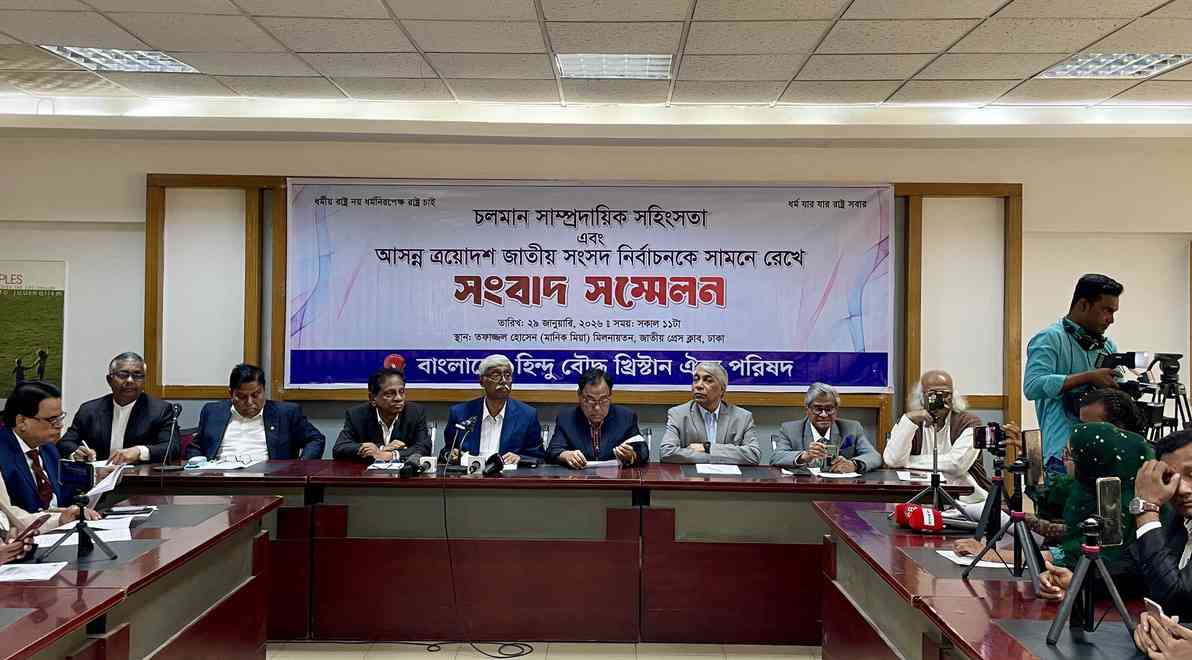
Hindu leaders claim that Bangladesh’s 8% Hindus can influence almost 100 out of 300 seats up for election. So if the Awami League’s minority vote were to move to the Bangladesh Nationalist Party, that would be a significant shot in the arm for the party.
To help along this shift, the Bangladesh Nationalist Party is moving to the centre. Campaign material put out by the party prominently features not only religious but also non-Bengali ethnic minorities. “The BNP is trying to occupy the Awami’s secular space and is moving from being a right of centre party to a more centrist party,” said Tapti Adhikari.
Along with a parliamentary election, Bangladesh is also conducting a referendum to reform its constitution. Most measures are meant to weaken the power of the government, putting in place many more powers for the Opposition – a move that observers say will help the Jamaat, which is widely expected to be the main opposition party.
For minorities, however, what is particularly worrying is that the referendum removes the word “secularism” from the constitution and replaces it with the more milquetoast “pluralism”.
“How can we ever vote ‘yes’ on the referendum?” Ranjan Karmakar asked. “It will be like cutting our own necks.”
However, a “no” vote also carries risk. “Since the interim government is itself campaigning for ‘yes’, we are under pressure,” he explained. “ If we vote ‘no’, minorities will be seen as traitors and violently targeted. So we are on the horns of a dilemma.”

Physical insecurity
Karmakar’s statement shows that whom to vote for is the lesser worry for many Bangladeshi Hindus. A greater concern is the possibility of post-election violence, especially in rural Bangladesh. Already, the fall of Hasina was followed by widespread attacks on minorities, both Hindus as well as the country’s largely Buddhist tribal communities.
In Gopalganj town, around three hours south of Dhaka, Arup Basak* says that he fears high levels of post poll violence as well as land grabbing once the election gets over. “Already, there is a crackdown here because Gopalganj is seen as an Awami hub,” he explained. “But right now they don’t want to mar the election. So we are scared that [violence] will come after.”
Basak was so wary of the attention that meeting an Indian journalist would bring in Gopalganj that he refused to meet me in person and instead spoke over the phone.
Sukriti Kumar Mondal, head of what he claims is Bangladesh’s only party that represents Hindus, the Bangladesh Minority Janata Party, disagreed with calls to boycott the vote. “People sitting in Dhaka don’t know anything,” he said. “We will have to vote to protect ourselves. We will vote for anyone, BNP or Jamaat, who can assure us of protection after the elections.”
Saurabh Ghosh bitterly described the elections an “excuse” to perpetrate violence on minorities. “If we vote for a party and it loses, the winners target us,” he said, referring to anti-Hindu violence following the 2001 Parliamentary elections in which workers of the Bangladesh Nationalist Party attacked Hindus because they were seen as having voted for the Awami League.
“And even if our party wins, then also it does not save us from being targeted,” Ghosh said, referring to various instances of anti-Hindu violence during the past 16 years of Awami rule.
